Fisher-price Little People Big Helpers Home Family Pack
Chances are, you've played with Fisher-Price'due south Trivial People toys at some point. The simple, round figures were a staple of toy boxes throughout the 1970s and '80s, and have become one of the longest-running toy lines in American history. With over 50 years on the market, the story behind these little folks is filled with fun and addicted memories, sure to bring out the child in all of us.
The Play Family Tree
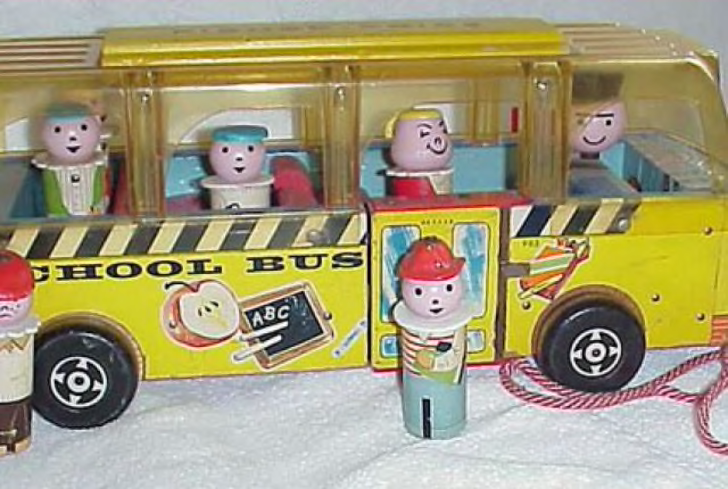
Niggling People has its roots in the early 1950s, where barrel-bodied figures with spherical heads were seen equally the drivers in pull-along toy cars. Just these characters were attached to the vehicles, so they were never the principal focus of play. All that changed when Fisher-Price introduced the Condom Bus in 1959. Like to its predecessors, the toy was a plastic school motorbus with the driver permanently attached. Notwithstanding, it also came with six child passengers who could exist removed from their seats. At present, instead of just pulling a toy auto backside them, children could brand the characters act out pretend scenarios and let their imaginations run wild.
The success of the Safety Bus inspired Fisher-Toll to release more than toys with removable figures, including the Snorky Fire Engine (1960), the Neat Station Wagon (1960), the Amusement Park (1963), and the Lacing Shoe (1965), which was the outset toy to feature the "Fisher-Price Play Family" name. ("Play Family" was the bodily name for the toys throughout well-nigh of their history. The proper name "Petty People" was just a nickname used by fans and wasn't officially trademarked by Fisher-Cost until 1985.)
Large Changes

While most of us think of the iconic "peg" style of Little People, with the abrupt taper at the waistline, it wasn't until 1965 that this design was finalized. Before that, the figures' bodies were directly cylinders, and so square, then triangular, and ane playset even had teardrop-shaped People. The peg style was the standard for decades, just then came the release of the 1986 best-seller Toys That Impale, a volume warning parents most dangerous toy recalls. Over the years, there had been reports of kids choking on Little People figures, but only after the toys had come up autonomously—which was a rare occurrence without some form of tampering. If the volume had merely mentioned the toy line, the public reaction might not have been that bad. But because 3 Little People were prominently featured on the cover, the figures became the spherical face of toy recalls. The controversy spelled the end of the peg design, simply there's no question information technology had a good run—from 1965 until 1990, well-nigh 800,000,000 Fiddling People had been sold.
To ease the minds of concerned parents, Fisher-Price went dorsum to the drawing board and released the "Mesomorphic" Little People, every bit collectors telephone call them, in 1991. The Chunky grade was substantially the same as the peg torso, simply wider and shorter to make the parts incommunicable to consume. But sales dropped sharply, as older kids felt the design catered too much to their little brothers and sisters, putting Little People into the very unpopular "baby toy" category for many youngsters.
The Chunky fashion never actually caught on, so, in 1997, Little People underwent yet another redesign. The figures were now molded plastic and featured greater detail on the face up, hair, and clothes. They as well had boosted attributes that changed the look of Picayune People forever—arms and hands. With a new look came a new direction for the toy line, every bit a scattering of figures were given names and personalities and so they could become identifiable characters. This brand anchor helped Piddling People break out into a claymation Boob tube show, books, alive performances, and even video games. Some child advocates were dismayed by this new aspect of the toys, saying that one of the greatest strengths of Little People over the years was that kids could invent their ain characters with the fairly generic figures. Yet, parents and kids still flock to the toys, the DVDs, the books, the alive evidence shopping mall tour, keeping the brand very popular today.
The Lucky 7
Many vintage Little People have names. The vii primary figures that made upward the basic Play Family line included, Mom, Dad, boys Pee Wee and Butch, girls Patty and Penny, and anybody'due south favorite, Lucky the canis familiaris. Of grade kids never used these names; they but substituted in whatever they liked. At various times, Fisher-Cost had named the dog Snoopy or Fido, merely when they plant out that kids were calling him Lucky instead, they decided non to fight information technology any longer and just fabricated that his official proper name.
Playsets Pack in the Fun

The key to Little People's success has always been the playset. For one cost, kids got figures, accessories, a vehicle, and a building they could use every bit the ground for their tiny adventures. The Play Family Farm was introduced in 1968, the kickoff "Play and Conduct" set where all the pieces could be stored inside the main edifice and carried by the plastic handle on the roof. This $9.99 set (nearly $sixty today) also marked the debut of the ingenious and infamous "Moo-ooo door," a mechanism that sounded like lowing cattle when you opened the barn door.
During the Little People heyday of the 1970s and '80s, Fisher-Cost released many playsets, including the Play Family unit Business firm (1969), the Action Garage with a existent, working elevator for cars (1970), the School (1971), the Airdrome (1972), the cowboys-and-Indians-inspired Western Town (1982), a Burn down Station (1982), and plenty more, which accept been released and re-released over the years with occasional design tweaks to go on them fresh. The Subcontract, however, has been their most successful playset, selling more 16.5 1000000 units since 1968. Information technology's all the same produced today, and the modern set features, in add-on to the "Moo-ooo door," the sounds of a horse, sheep and chicken likewise.

Ane of the nigh popular Little People playsets, Sesame Street, debuted in 1975, condign the first licensed toy in the lineup. The playset was a recreation of the bear witness's urban locations and included characters like Bert, Ernie, Big Bird, Oscar the Grouch, Cookie Monster, and the only iii vintage Little People that were based on real people, Mr. Hooper (Will Lee), Gordon (Roscoe Orman), and Susan (Loretta Long). The ready was an instant striking, and then Fisher-Price released some other, the Sesame Street Clubhouse, in 1977. The Clubhouse was an original surroundings designed solely for the toy line and never appeared on the actual show. But kids didn't seem to mind because the set featured plenty of absurd stuff, similar trap doors, slides, and a moving sidewalk. This set up included Large Bird, Bert, Ernie, the Count, Grover, and Roosevelt Franklin. To add together to the Muppet bandage, Fisher-Price sold packs of Sesame Street figures separately that included Prairie Dawn, Herry Monster, Sherlock Hemlock, and Mr. Snuffleupagus. The Sesame Street line was only produced for four years, ending in 1979, just it was long enough to make a lasting impression on a generation of kids.

It was xv years after the Sesame Street prepare debuted that Fisher-Price partnered with McDonald's to release their next licensed playset. In 1990, just earlier the peg trunk type was redesigned, a Mickey D'south eating house set was packaged with Footling People versions of Ronald McDonald and the Hamburglar. When the figure design inverse to the Chunky torso a year later, the McDonald'due south set changed with it. And when the Chunky sales dropped, so did the sales of the McDonald'south set, pregnant it was only on the market for a couple of years earlier information technology was discontinued.
The Sincerest Form of Flattery
Of course with great prosperity comes those who want a piece of the pie. During the Little People'south heyday, many companies produced characters that were at the very to the lowest degree inspired by the Petty People design. PlaySkool, for example, released a series of playsets and figures called "Familiar Places," which were almost the same size as Lilliputian People, only whose bodies and heads were square. Toy manufacturer Illco went so far as to make Disney and Peanuts figures that were and then similar to the peg design, they could actually fit into Trivial People furniture and cars.
DIY Picayune People

For some crafty fans, just because Fisher-Price never released Fiddling People in the form of some of their favorite characters, that hasn't stopped them from making their own. With a piffling paint, some modeling clay, and a whole lot of love, fans take modified Little People to look like the cast of The Lord of the Rings, the Muppets, Indiana Jones, and such not-kiddie fare as The X-Files. One of the more than unusual Petty People bootleggers is musician and pop civilization geek, Suckadelic. Through his website, fans can buy express edition Lilliputian People made to await like characters from Star Wars, Yard.I. Joe, the shark from Jaws, besides as Suckadelic'south ain unusual creations.
craddockefivishereme.blogspot.com
Source: https://www.mentalfloss.com/article/26320/little-people-big-fun-brief-history-fisher-price-little-people

Post a Comment for "Fisher-price Little People Big Helpers Home Family Pack"