List the Retail Cuts on a Beef

Product Reviews / Main Nibbles / Beef
Retail Cuts Of Beef
Beef Glossary Page 6: Beef Cuts Starting time With
Q & R
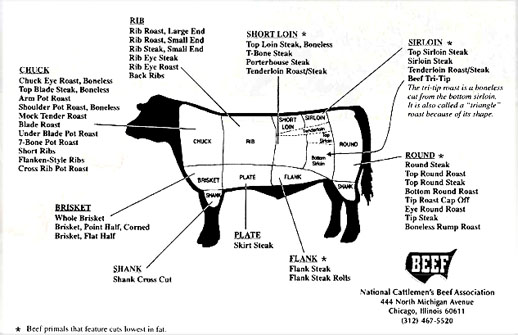
Retail cuts of beef: When looking upwards cuts of meat, information technology'due south helpful to refer to the beef cut diagram, courtesy of the National Cattleman's Beef Association. If you enjoy this Beef Glossary, we take a food glossary for almost every category of food.
Click on a letter to become to the appropriate glossary folio.
a b c d e f 1000 h i j k l m n o p q r s t u v w x y z
This glossary is protected by copyright and cannot be reproduced in whole or part.
You are welcome to link to it.
QUALITY GRADING
Quality grades help predict the expected palatability of beef. The grade is based primarily on two factors: the corporeality of marbling in the rib-centre muscle and the age of the animal. These can be adjusted for other factors such as the color of the lean beef. The USDA Quality Grades are Prime number, Choice, Select, Standard, Commercial, Utility, Cutter, and Canner. Each grade denotes a specific level of quality that is determined by the USDA Grading Service.
Reddish MEAT
Red meats include beef, lamb, pork, and veal.
REGENERATIVE MEAT
Regenerative meat products are sourced from farmers who do regenerative agriculture, which aims to contrary the furnishings of climatic change by rebuilding organic matter in soil and restoring degraded soil biodiversity. Regenerative meat must be organic and grass-fed. Regenerative Organic Certified™ is a new certification for nutrient, textiles, and personal care ingredients, attesting that farms and products encounter the highest standards in the earth for soil wellness, animal welfare, and farmworker fairness. Learn more from the Regenerative Organic Allliance (ROA).
RIB CUTS
Cuts from the rib portion of the moo-cow are a dandy combination of both season and tenderness. They are an excellent pick for grilling and broiling. The steaks that come from the rib are rib steak and rib eye (see below). Other cuts from the rib include baby back ribs, rib roasts, and short ribs. The rib steak is a rich and juicy steak cutting from the rib section of the steer, and it contains a section of the rib bone. It has a generous amount of fat, and frequently has more marbling than a top loin, which provides the excellent flavor. The rib-middle steak was traditionally the boneless version of the rib steak, only today's terminology calls them both rib middle, with the clarification of bone in or bone out/boneless.
RIB-EYE or RIBEYE STEAKAlso known equally the dazzler steak, c ôte de boeuf (with bone in), cowboy steak (with bone in), Delmonico and Spencer steak, this flavorful, cut of prime rib (i.e., a boneless rib steak) is a favorite of steak lovers. Due to its rich marbling of fat, it is one of the virtually flavorful and juicy of steaks. It is also only a little less tender than the tenderloin, while calculation a lot more flavorful because of the rich marbling. Ordering with the bone in makes it more delicious. In its uncut class, the rib eye is known as the rib roast (prime rib). Come across as well rib cuts. RIB-Heart CAPThe tastiest and tenderest portion of the rib-eye, this is the well-marbled, crescent-shaped outer rim of the rib center (in the photo, on the left side of the steaks). Information technology'southward a rib-eye lover's favorite part of the steak. | 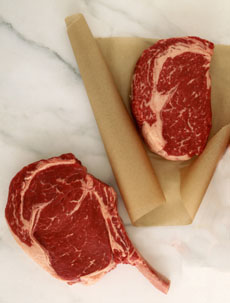 Rib-eye steaks, shown bone in and os out. The cap is the crescent-shaped outer rim. Photograph courtesy of Morton'south The Steakhouse. |
RIB ROAST
A beef roast from the rib department between the chuck and the short loin. The 3 most popular styles are standing rib roast, rolled rib roast, and rib-heart roast. The standing rib roast ordinarily includes at least three ribs (less than that is really just a very thick steak). It'south roasted continuing upright, resting on its rack of ribs, thereby assuasive the top layer of fat to cook and cocky-baste the meat. A rolled rib roast has had the bones removed before beingness rolled and tied into a cylinder. The boneless rib-eye roast is the center, virtually desirable, and well-nigh tender portion, and nigh expensive portion of the rib section. A prime rib roast is the finest quality rib roast, USDA Prime, available only from top butchers.
RIB STEAK
A rib-eye steak with the bone-in.
ROASTA multi-pound piece of meat, generally cooked via radiant rut in an oven and sliced into multiple portions. Before modernistic ovens, roasts were cooked on a spit over a burn down. Roasts are cut from almost every expanse along the top of the steer: chuck roast, rib roast, chateaubriand (from the brusque loin), sirloin tip roast, top round roast, eye of the circular roast, and rump roast (round). Roasts are best served medium rare to medium (the internal temperature on a meat thermometer should be 150°F to 155°F at serving time). Always take a roast out of the oven when it is at to the lowest degree 10 degrees below serving temperature and permit it rest for 10 to 15 minutes before etching. | 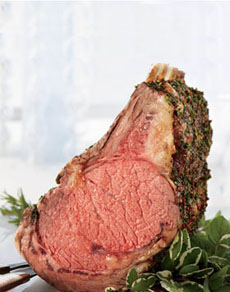 A prime number rib roast, available from Allen Brothers. |
Circular
The round is the hind section of the beef. Since the rear of the animal has been toughened by exercise, the round is less tender than the rib, brusque loin, and sirloin cuts. However, many steak lovers feel that it offers the best combination of texture and flavor. Cuts from the round include lesser round, cube steak, eye of the round, top round, circular tip, and rump steak.
| 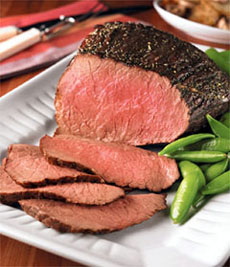 Top circular roast. Photo courtesy GlacierBeef.com. |
| 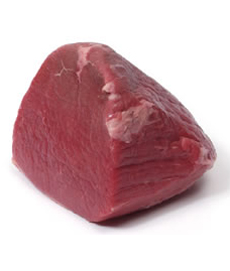 Eye of circular roast. Photo courtesy GlacierBeef.com. |
RUMP ROAST
The rump is a flavorful, triangular cutting of meat taken from the upper function of the round. It is generally cut, boned, and rolled into two or iii rump roasts that. When the bone is left in, the cutting is referred to equally a standing rump roast.
Get To Side by side Folio, Terms Beginning With South
Become To Glossary Alphabet Alphabetize, Above
Lifestyle Direct, Inc. Some definitions were provided by the Cattlemen's Beefiness Board and are © Copyright 2005 Cattlemen's Beef Board. All rights reserved. Images are the copyright of their respective owners.
© Copyright 2005-2022 Lifestyle Direct, Inc. All rights reserved. All images are copyrighted to their respective owners.
craddockefivishereme.blogspot.com
Source: https://www.thenibble.com/reviews/main/meats/beef/glossary6.asp

Post a Comment for "List the Retail Cuts on a Beef"