Sculpture of Goose and Woman in Love at the Detroit Institute of Arts
 | |
 | |
| Established | 1885 |
|---|---|
| Location | 5200 Woodward Avenue Detroit, Michigan |
| Coordinates | 42°21′34″N 83°03′53″W / 42.35944°N 83.06472°W / 42.35944; -83.06472 Coordinates: 42°21′34″N 83°03′53″W / 42.35944°N 83.06472°W / 42.35944; -83.06472 |
| Type | Fine art museum |
| Drove size | 65,000 works[1] |
| Visitors | 677,500 (2015)[1] |
| Founder | Wilhelm Valentiner[one] |
| Managing director | Salvador Salort-Pons |
| Public transit admission | QLINE: Warren / Ferry DDOT, SMART |
| Website | www.dia.org |
| Detroit Institute of Arts | |
| U.S. Historic district | |
| Congenital | 1927 |
| Architect | Paul Philippe Cret |
| Architectural way | Beaux-Arts, Italian Renaissance |
| Restored | 2007 |
| Restored by | Michael Graves |
| Part of | Cultural Middle Historic District (ID83003791) |
| Designated CP | November 21, 1983 |
The Detroit Institute of Arts (DIA), located in Midtown Detroit, Michigan, has one of the largest and most significant art collections in the United states. With over 100 galleries, it covers 658,000 square feet (61,100 g2)[2] [3] with a major renovation and expansion project completed in 2007 that added 58,000 foursquare feet (5,400 grand2).[2] The DIA collection is regarded equally among the pinnacle half dozen museums in the United states of america with an encyclopedic collection which spans the earth from ancient Egyptian and European works to contemporary art.[2] Its fine art collection is valued in billions of dollars, upward to $8.1 billion according to a 2014 appraisal.[4] [5] The DIA campus is located in Detroit's Cultural Center Historic District, about two miles (iii km) due north of the downtown area, beyond from the Detroit Public Library nearly Wayne Land University.
The museum building is highly regarded by architects.[6] The original building, designed by Paul Philippe Cret, is flanked by northward and south wings with the white marble as the main exterior textile for the unabridged construction. The campus is part of the city's Cultural Center Celebrated District listed in the National Register of Historic Places. The museum'southward get-go painting was donated in 1883 and its collection consists of over 65,000 works. With about 677,500 visitors annually for 2015, the DIA is among the most visited fine art museums in the world.[1] [vii] The Detroit Plant of Arts hosts major art exhibitions; it contains a ane,150-seat theatre designed by builder C. Howard Crane, a 380-seat hall for recitals and lectures, an art reference library, and a conservation services laboratory.[ane]
Collections [edit]
The museum contains 100 galleries of fine art from around the globe.[8] Diego Rivera'southward Detroit Industry bike of frescoes span the upper and lower levels to surround the central thousand marble court of the museum. The armor collection of William Randolph Hearst lines the main hall entry way to the grand court. The drove of American art at the DIA is one of the virtually impressive, and officials at the DIA have ranked the American paintings collection tertiary amidst museums in the The states. Works by American artists began to be nerveless immediately post-obit the museum'due south founding in 1883. Today the collection is a strong survey of American history, with best-selling masterpieces of painting, sculpture, piece of furniture and decorative arts from the 18th century, 19th century, and 20th century, with contemporary American art in all media too being nerveless. The breadth of the drove includes such American artists as John James Audubon, George Bellows, George Caleb Bingham, Alexander Calder, Mary Cassatt, Dale Chihuly, Frederic Edwin Church, Thomas Cole, John Singleton Copley, Robert Colescott, Leon Dabo, Thomas Wilmer Dewing, Thomas Eakins, Childe Hassam, Robert Henri, Winslow Homer, George Inness, Martin Lewis, Georgia O'Keeffe, Charles Willson Peale, Rembrandt Peale, Tom Phardel, Duncan Phyfe, Hiram Powers, Sharon Que, Frederic Remington, Paul Revere, Augustus Saint-Gaudens, John Vocaliser Sargent, John French Sloan, Tony Smith, Marylyn Dintenfass, Gilbert Stuart, Yves Tanguy, Henry Ossawa Tanner, Louis Comfort Tiffany, Andy Warhol, William T. Williams, Anne Wilson, Andrew Wyeth, and James McNeill Whistler.

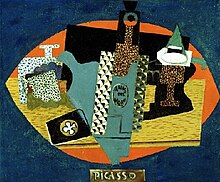
Pablo Picasso, 1916, L'anis del mono (Bottle of Anis del Mono), oil on sail, 46 x 54.6 cm
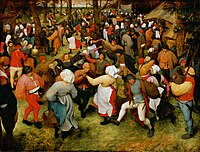
The early on 20th century was a period of prolific collecting for the museum, which caused such works as a dragon tile relief from the Ishtar Gate of Babylon, an Egyptian relief of Mourning Women and a statuette of a Seated Scribe, Pieter Bruegel the Elder's The Hymeneals Trip the light fantastic toe, Saint Jerome in His Report by January van Eyck and Giovanni Bellini's Madonna and Child. Early on purchases included French paintings by Claude Monet, Odilon Redon, Eugène Boudin, and Edgar Degas, likewise as Old Masters including Gerard ter Borch, Peter Paul Rubens, Albrecht Dürer and Rembrandt van Rijn. The museum includes works past Vincent van Gogh including a self-portrait. The self-portrait of Vincent van Gogh and The Window by Henri Matisse were purchased in 1922 and were the offset paintings by these 2 artists to enter an American public drove. Later important acquisitions include Hans Holbein the Younger's Portrait of a Adult female, James Abbott McNeill Whistler's Nocturne in Black and Gold: The Falling Rocket, and works past Paul Cézanne, Eugène Delacroix, Auguste Rodin, Jean-Baptiste Carpeaux and François Rude. German language Expressionism was embraced and collected early on on past the DIA, with works by Heinrich Campendonk, Franz Marc, Karl Schmidt-Rottluff, Max Beckmann, Karl Hofer, Emil Nolde, Lovis Corinth, Ernst Barlach, Georg Kolbe, Wilhelm Lehmbruck, Erich Heckel, Ernst Ludwig Kirchner, Paula Modersohn-Becker, and Max Pechstein in the collection. Non-German artists in the Expressionist move include Oskar Kokoschka, Wassily Kandinsky, Chaïm Soutine and Edvard Munch. The Nut Gatherers by William-Adolphe Bouguereau is, past some accounts, the nearly pop painting in the drove.
In add-on to the American and European works listed above, the collections of the Detroit Found of Arts are more often than not encyclopedic and extensive, including aboriginal Greek, Roman, Etruscan, Mesopotamian, and Egyptian material, as well as a wide range of Islamic, African and Asian fine art of all media.
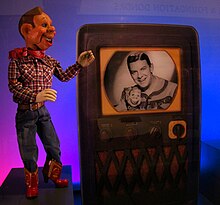
In December 2010, the museum debuted a new permanent gallery with special collections of paw, shadow, and string puppets along with programmable lighting and original backgrounds. The museum plans to feature puppet related events and rotation of exhibits drawn from its puppet collections.[9]
Exhibitions [edit]

The main hall of the DIA leading to the Rivera Court


Hall between old and new sections
Artists' Take on Detroit: Projects for the Tricentennial (Oct xix, 2001 – December 28, 2001) This showroom celebrates Detroit's 300th anniversary by creating x projects that stand for the city. The installations created past xv artists include video and nevertheless photography, text and audio, and sculptures. This showroom includes the post-obit: Chantry Mary by Petah Coyne, Strange Früt: Rock Apocrypha by Destroy All Monsters Collective, Traces of And so and At present by Lorella Di Cintio and Jonsara Ruth, Fast Forrad, Play Dorsum past Ronit Eisenbach and Peter Sparling, Riches of Detroit: Faces of Detroit by Deborah Grotfeldt and Tricia Ward, Open House by Tyree Guyton, A Persistence of Memory past Michael Hall, Relics past Scott Hocking and Clinton Snider, Blackout by Mike Kelley, Voyageurs past Joseph Wesner [10]
Art in Focus: Celadons (January 16 – April 14) Light-green-glazed ceramics, also known every bit celadon ware, created by Suzuki Sansei are on display in each of the Asian galleries. [11]
Over the Line: The Art and Life of Jacob Lawrence (February 24, 2002 – May 19, 2002) The exhibit contains work of the African American artist Jacob Lawrence (1917–2000), and includes never before seen pieces from the Migration and the John Brown series. [12] [13]
Degas and the Dance (October twenty, 2002 – January 12, 2003) This exhibit includes more than 100 pieces of work created by Edgar Degas. These pieces include model phase sets, costume designs, and photographs of the dancers from the 19th-century Parisian ballet. [xiv]
Magnificenza! The Medici, Michelangelo and The Art of Late Renaissance Florence (March 16, 2003 – June eight, 2003) The exhibit displays art of the cultural successes of the first 4 Medici m dukes of Tuscany during 1537–1631, forth with their connection with Michelangelo and his art in the Belatedly Renaissance Florence. [15]
When Tradition Changed: Modernist Masterpieces at the DIA (June 2003 – Baronial 2003) This exhibit only contains pieces from the DIA's collection from the tardily 19th-century and early 20th-century and displays the different choices artists expressed themselves after 1900. [16]
Then and At present: A selection of 19th- and 20th-Century Art by African American Artists (July 2003 – August 2003) Roughly 40 objects in this showroom, organized by the Full general Motors Center for African American Art, brandish the artistic styles of African American artists during the past ii hundred years. This exhibit includes piece of work from Joshua Johnson, Robert Scott Duncanson, Henry Ossawa Tanner, Augusta Savage, Benny Andrews, Betye Saar, Richard Hunt, Sam Gilliam, and Lorna Simpson. Allie McGhee, Naomi Dickerson, Lester Johnson, Shirley Woodson, and Charles McGee are some of the Detroit artists that were included in the installation. [17]
Art in Focus: Buddhist Sculpture (Through July 14, 2003) This showroom contains one Buddhist sculpture in each of the Asian galleries. These sculptures symbolize enlightenment, selflessness, wisdom and tranquility. [18]
Yoko Ono's Freight Train (September 17, 2003 – July 19, 2005) Freight Train, constructed by Yoko Ono in 1999, is a German boxcar with bullet holes and is set on a department of railroad track displayed outdoors. [19] [20]
Art in Focus: Mother-of-Pearl Inlaid Lacquer (Through Oct 13, 2003) This showroom contains lacquer wares made from sap of lacquer trees. [21]
Style of the Century: Selected Works from the DIA'southward Collection (Through October 27, 2003) [22]
Some Fluxus: From the Gilbert and Lila Silverman Fluxus Collection Foundation (Through October 28, 2008) The exhibit contains works from the Fluxus grouping, named past artist and provocateur George Maciunas. [23]
Trip the light fantastic of the Forest Spirits: A Set of Native American Masks at the DIA (Through October vi, 2003) Wooden masks made in the 1940s to represent the spirit world made past the Kwakwaka'wakw (Native Americans of the Northwest coast) are displayed in the exhibit, forth with interactive videos, listening stations, and computer activities. [24]
Dawoud Bey: Detroit Portraits (April 4, 2004 – August 1, 2004) Dawoud Bey's work created during a 5-week residency at Chadsey Loftier School includes large-format, color photographic portraits along with a video of students from Chadsey High Schoolhouse is displayed in this exhibit. Selected artwork of students from writing and fine art workshops that are conducted by Bey and the art kinesthesia at Chadsey and conduct discussion will also exist displayed. [25]
Pursuits and Pleasures: Bizarre Paintings from the Detroit Plant of Arts (Apr ten, 2004 – July 4, 2004) Pieces of work by Aelbert Cuyp, Giovanni Paolo Panini, Jacob van Ruisdael, Mathieu le Nain, Claude Lorrain, Gerard Ter Borch, Frans Snyders, and Thomas Gainsborough are displayed in this exhibit, organized by the Kresge Art Museum, the Dennos Museum Center, the Kalamazoo Plant of Arts, and the Muskegon Museum of Art, forth with the Detroit Institute of Arts. [26]
The Carving Revival in Europe: Late Nineteenth- and Early- Twentieth Century French and British Prints (May 26, 2004 – September nineteen, 2004) Examples of carving work of James McNeill Whistler, Francis Seymour Haden, Charles Meryon, Édouard Manet, Jean-François Millet, and Frank Brangwyn are displayed in this showroom. [27]
The Photography of Charles Sheeler: American Modernist (September viii, 2004 – December v, 2004) Prints from Charles Sheeler's major series are displayed in this exhibit, including images of his business firm and barns in Doylestown, Pennsylvania captured in 1916 and 1917; stills from the 1920 film Manhatta; photographs of Chartres Cathedral taken in 1929; and images of American industry created in the 1930s for Fortune magazine. Also displayed are Sheeler'southward views from the Ford Motor Company'south River Rouge complex commissioned by Edsel Ford in 1927. [28]
Murano: Drinking glass From the Olnick Spanu Collection (Dec 12, 2004 – February 27, 2005) The showroom displays about 300 Venetian blown glass pieces fabricated in the 20th-century, organized in chronological lodge. [29]
Gerard ter Borch (Feb 27, 2005 – May 22, 2005) The exhibit contains paintings of the 17th-century Dutch life created by Gerard ter Borch. [thirty]
Beyond Big: Oversized Prints, Drawings and Photographs (March 16, 2005 – July 31, 2005) The showroom displays big prints, drawings, and photographs by Abelardo Morrell, Anna Gaskell, Jenny Gage, Justin Kurland, Gregory Crewdson, Richard Diebenkorn, Jasper Johns, Robert Rauschenber, Judy Pfaff, Charles Burchfield, and others. [31]
Threescore-Eighth Almanac Detroit Public Schools Student Exhibitions (Apr 9, 2005 – May 14, 2005) Kindergarten through 12th grade students will accept their work displayed at the Detroit Public Library because of renovations at the DIA. This exhibit contains hundreds of ceramics, paintings, drawings, sculptures, and videos. [32]
Camille Claudel and Rodin: Fateful Encounter (Oct ix, 2005 – February v, 2006) The showroom contains work by Auguste Rodin and Camille Claude. Sixty-two sculptures by Claudel and l-viii by Rodin created before the two artists met forth with sculptures created during the good and bad years of their relationship are displayed. Some works created past Claudel that will exist displayed include Sakuntala, The Flit, La Petite Châtelain, The Age of Maturity, The Wave, and Vertumnus and Pomona. Works of Rodin that will be displayed include Bust of Camille Claudel, Saint John the Baptist Preaching, Balzac, and The Gates of Hell. [33]
African American Art from the Walter O. Evans Drove (April 9, 2006 – July two, 2006) Selected pieces in diverse media from Walter O. Evan's private drove will exist displayed in the exhibit. Piece of work by African American artists during the 19th and 20th centuries including Henry Ossawa Tanner, Edmonia Lewis, Elizabeth Catlett, Aaron Douglas, Romare Bearden, and Jacob Lawrence will exist displayed also. [34]
Sixty-Ninth Almanac Detroit Public Schools Educatee Exhibit (April 20, 2006 – May 14, 2006) Kindergarten through 12th grade students will take their work displayed at the Detroit Public Library because of renovations at the DIA. This exhibit contains ceramics, drawings, collages, jewelry, and more than. [35]
Recent Acquisitions: Prints, Drawings, and Photographs (May 17, 2006 – July 31, 2006) The exhibit contains works from the 1500s through the 2000s including prints by artists such every bit Giorgio Ghisi, Judy Pfaff, Terry Winters, and drawings by Adolph Menzel, and Stephen Talasnik. Piece of work by early 20th-century photographers by Edwin Hale Lincoln, Alvin Langdon Coburn, and Tina Modotti are displayed. Work by contemporary artists Larry Fink, Candida Hofer, and Kiraki Sawi are also displayed. [36]
The Big Three in Printmaking: Dürer, Rembrandt and Picasso (September thirteen, 2006 – December 31, 2006) The exhibit features piece of work of Dürer in the early 16th century, Rembrandt in the mid-17th century, and Picasso in the 20th century made of various media including forest and linoleum cuts, engraving, etching, aquatint, drypoint and lithography. [37]
Annie Leibovitz: American Music (September 24, 2006 – January 7, 2007) Annie Leibovitz's photographs of legends of roots music and younger artists influenced past them are displayed in the exhibit. Lxx portraits of hers are displayed in the exhibit, including B.B. King, Johnny Cash and June Carter, Willie Nelson, Pete Seeger, Etta James, Dolly Parton, Beck and Bruce Springsteen, Eminem, Aretha Franklin, Iggy Pop, Patti Smith, and The White Stripes. [38]
Ansel Adams (March 4, 2007 – May 27, 2007) The exhibit contains over 100 blackness and white photographs taken by Ansel Adams ranging from the early on 1900s to the 1960s. This exhibit contains photographs of landscapes, Pueblo Indians, mountain views, along with portraits of his friends Georgia O'Keeffe, John Marin, and Edward Weston. [39]
Seventieth Almanac Detroit Public Schools Student Exhibition (March 31, 2007 – May 5, 2007) Kindergarten through twelfth grade students will have their work displayed at the Detroit Public Library because of renovations at the DIA. This exhibit contains ceramics, drawings, collages, jewelry, and more. [40]
The Best of the Best: Prints, Drawings, and Photographs from the DIA Drove (November 23, 2007 – March 2, 2008) The DIA has chosen over 100 of the "best" prints, drawings, and photographs out of the museums 35,000 pieces of work to be displayed in the showroom. Some pieces that will be displayed are Michelangelo'south double-sided chalk and pen and ink drawing of 1508 showing ornamentation schemes for the Sistine Chapel ceiling; Russet Landscape by Edgar Degas from the 1890s; and Wheels by Charles Sheeler in 1939. [41]
Architecture [edit]

Detroit Institute of Arts
Earlier 1920, a committee was established to choose an builder to design a new building to business firm the DIA'due south expanding collections. The commission included DIA President Ralph H. Booth, William J. Gray, architect Albert Kahn and industrialist Edsel Ford. Westward.R. Valentiner, the museum director, acted as art director and Clyde H. Burroughs was the secretary. The group chose Philadelphia architect Paul Philippe Cret as the lead architect and the firm of Zantzinger, Borie and Medary as associated architects, with Detroit architectural firms of Albert Kahn and C. Howard Crane contributing "advice and suggestions."[42]
The cornerstone for new Beaux-Arts, Italian Renaissance styled building was laid June 26, 1923 and the finished museum was dedicated October 7, 1927.[43]
In 1922, Horace Rackham donated a casting of Auguste Rodin'southward sculpture, The Thinker, acquired from a German collection, to the museum where it was exhibited while the new building was nether construction. The work was placed in the Groovy Hall of the new museum building. One-time in the subsequent years the piece of work was moved out of the building and placed on a pedestal in front of the building, facing Woodward Avenue and the Detroit Public Library beyond the street which was also constructed of white marble in the Beaux-Arts, Italian Renaissance style .

The Gothic Chapel, equally viewed in 1929
The due south and due north wings were added in 1966 and 1971 respectively. Both were designed by Gunnar Birkerts and were originally faced in blackness granite to serve as a backdrop for the original white marble building. The south fly was later named in award of museum benefactors Edsel and Eleanor Ford and the north wing for Jerome Cavanaugh who was Detroit Mayor during the expansion.[43] [44]
The building as well incorporates a 16th-century French Gothic chapel, donated by Ralph H. Booth.[45]
William Edward Kapp, architect for the business firm of Smith, Hinchman & Grylls has been credited with interior design work on the Detroit Institute of Art.[46]
Artwork [edit]

Edsel Ford commissioned murals past Diego Rivera for DIA in 1932.[47] [48] Composed in fresco fashion, the five sets of massive murals are known collectively as Detroit Industry, or Man and Machine.[49] The murals were added to a large central courtyard; it was roofed over when the work was executed. The Diego Rivera murals are widely regarded as keen works of fine art and a unique characteristic of the museum.[50] Architect Henry Sheply, a close friend of Cret'south would write: "These [murals] are harsh in color, scale and composition. They were designed without the slightest idea given to the frail architecture and ornamentation. They are quite simply a travesty in the name of art."[51] Their politically charged themes of proletariat struggle caused lasting friction between admirers and detractors.[52] During the McCarthy era, the murals survived only by ways of a prominent sign which identified them as legitimate art; the sign further asserted unambiguously that the political motivations of the creative person were "detestable".[48] Today the murals are historic equally one of the DIA'due south finest assets, and even "one of America'south well-nigh significant monuments".[53]
The building also contains intricate iron work past Samuel Yellin, tile from Pewabic Pottery, and architectural sculpture past Leon Hermant.[42]
Renovation and expansion [edit]
In November 2007, the Detroit Institute of Arts building completed a renovation and expansion at a total cost of $158 1000000. Architects for the renovation included the Driehaus Prize winner Michael Graves and assembly forth with the SmithGroup.[54] The projection, labeled the Master Plan Project, included expansion and renovation of the northward and south wings as well every bit restoration of the original Paul Cret building, and added 58,000 additional square feet, bringing the total to 658,000 square feet.[ii] The renovated exterior of the northward and due south wings was refaced with white marble acquired from the same quarry equally the marble on the main edifice designed by Paul Cret.[54] The major renovation of the Detroit Institute of Arts has provided a meaning example of report for museum planning, function, management, and design.[55]
History [edit]
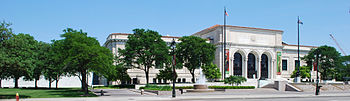
Detroit Found of Arts
The Museum had its genesis in an 1881 tour of Europe made past local paper magnate James E. Scripps. Scripps kept a journal of his family's five-month tour of fine art and culture in Italy, French republic, Frg, and kingdom of the netherlands, portions of which were published in his paper The Detroit News. The serial proved so pop that it was republished in volume form called Five Months Abroad. The popularity inspired William H. Brearley, the manager of the paper'southward advertising department to organize an art exhibit in 1883, which was likewise extremely well received.
Brearly convinced many leading Detroit citizens to contribute to found a permanent museum. It was originally named the Detroit Museum of Art. Amongst the donors were James E. Scripps, his brother George H. Scripps, Dexter Grand. Ferry, Christian H. Buhl, Gen. Russell A. Alger, Moses W. Field, James McMillan and Hugh McMillan, George H. Hammond, James F. Joy, Francis Palms, Christopher R. Mabley, Simon J. Murphy, John South. Newberry, Cyrenius A. Newcomb, Sr., Thomas West. Palmer, Philo Parsons, George B. Remick, Allan Shelden, William C. Weber, David Whitney Jr., George 5. N. Lothrop, and Hiram Walker.
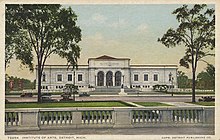
Detroit Institute of Arts, circa 1910s
With much success from their first exhibit, Brearley so challenged twoscore of Detroit'south leading and prominent businessmen to contribute $one,000 each to help fund the building of a permanent museum. With $50,000 coming from Scripps lone, their goal was inside accomplish. By 1888, Scripps and Brearley had incorporated Detroit Museum of Arts, filling it with over 70 pieces of artwork acquired by Scripps during his time in Europe.[56]
Lasting as a museum less than forty years, the bear on the museum had on the urban center of Detroit was tremendous. The Fine art Loan Exhibition'due south success in 1883 had led to the creation of a board. The purpose of the board was to raise and establish funds to build a permanent art museum in the city. Donating coin to the cause were some of Detroit's biggest names, including James E. Scripps, George H. Scripps, Russell A. Alger, and Sen. Thomas Palmer. The old Detroit Museum of Fine art building opened in 1888 at 704 E. Jefferson Avenue (it was finally demolished in 1960). The Detroit Museum of Art board of trustees inverse the name to the Detroit Institute of Arts in 1919 and a committee began raising funds to build a new location with Scripps however at the helm. The present DIA building on Woodward Avenue debuted on Oct 7, 1927. While not officially declared the founder of the Detroit Found of Arts, Scripps and Brearley were indeed the founders of the DIA's predecessor, The Detroit Museum of Fine art. With the success of the arts, and the booming car industry, families were flocking to the city; pushing for the need to expand the vision that Scripps had originally dreamed, a new building was raised and the DIA was built-in.
Another conclusion in 1919 that would have a lasting impact on the future of the museum was transferring ownership to the City of Detroit with the museum becoming a metropolis section and receiving operating funds. The board of trustees became the Founder's Social club a private support grouping that provided additional coin for acquisitions and other museum needs. The museum sought the leadership of German fine art scholar Wilhelm Valentiner. It equally under Valentiner'due south leadership as director that, the museum flush with coin from a booming city and wealthy patrons, the size and quality of the DIA's collections grew significantly. The DIA became the first U.S. museum to learn a van Gogh and Matisse in 1922 and Valentiner's relationship with German expressionist led to significant holdings of early Modernist art.[57]
Valentiner likewise reorganized how fine art was displayed at the museum. Breaking with the tradition of organizing artworks by their type with, for instance, painting grouped together in ane gallery and sculpture in another. Valentiner organized them by nation and chronology, this was recognized as being and then revolutionary that the 1929 Encyclopædia Britannica used an illustration of the principal floor program of the DIA as an instance of the perfect modern fine art museum.[57]
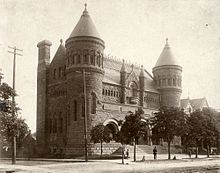
The quondam Detroit Museum of Art stood at 704 Eastward. Jefferson Ave. The building opened in 1888
Support for the museum came from Detroit philanthropists such as Charles Lang Freer, and the automobile barons: art and funds were donated by the Dodges, the Firestones and the Fords, particularly Edsel Ford and his wife Eleanor, and subsequently their children. Robert Hudson Tannahill of the Hudson's Department Store family unit, was a major distributor and supporter of the museum, donating many works during his lifetime. At his death in 1970, he bequeathed a big European art drove, which included works by Paul Cézanne, Vincent van Gogh, Paul Gauguin, Edgar Degas, Georges Seurat, Henri Rousseau, Henri Matisse, Pablo Picasso, Constantin Brâncuși, of import works of German language Expressionism, a big collection of African fine art, and an endowment for future acquisitions for the museum. Office of the current support for the museum comes from the country government in exchange for which the museum conducts statewide programs on art appreciation and provides art conservation services to other museums in Michigan.

In 1949, the museum was among the first to return a piece of work that had been looted by the Nazis, when it returned Claude Monet'south The Seine at Asnières to its rightful owner. The art dealer from whom they had purchased it reimbursed the museum. In 2002, the museum discovered that Ludolf Backhuysen's A Human-O-War and Other Ships off the Dutch Declension, a 17th-century seascape painting under consideration for buy by the museum, had been looted from a private European collection past the Nazis. The museum contacted the original owners, paid the rightful restitution, and the family unit immune the museum to accretion the painting into its collection, adding some other painting to the museum's already prominent Dutch collection. In some other example, Detroit Plant of Arts v. Ullin, which involved a claim concerning Vincent van Gogh's "Les Becheurs (The Diggers)" (1889), the museum successfully asserted that Michigan's iii-year statute of limitations precluded the court or a jury from deciding the merits of the case.[58]
The museum was expanded with a due south and north fly in 1966 and 1971, respectively, giving space for the museum to receive two big gifts in 1970, the collection of Robert Tannahill and Anna Thompson Dodge bequeathed the 18th-century French contents of the music room from her home, Rose Terrace, to the museum upon her decease.[57]
Every bit the fortunes of the metropolis declined in the 1970s and 80s so did its ability to support the DIA. In 1975, even with reduced staff, the city was forced to close the museum for three weeks in June. The Country of Michigan provided funding to reopen and over this time period the state would play an increasing function in funding the museum.[57]
A 1976 souvenir of $1 million from Eleanor Ford created the Department of African, Oceanic and New Globe Cultures.[44]
Past 1990, 70 percentage of the DIA's funding was coming from the State of Michigan, that year the state facing a recession and upkeep arrears cut funding by more 50 percent. This resulted in the museum having to close galleries and reduce hours, a fundraising entrada led by Joseph 50. Hudson was able to restore operations.[57]
In 1998, the Founder's Guild signed an operating agreement with the Urban center of Detroit that would accept the Founder's Society operating every bit Detroit Establish of Arts, Inc have over direction of the museum from the Art Department with the urban center retaining buying of the DIA itself.[57]
On Feb 24, 2006, a 12-year-old boy stuck a piece of chewing gum on Helen Frankenthaler'south 1963 abstract work The Bay, leaving a small stain. The painting was valued at $1.5 million in 2005, and is i of Frankenthaler's most important works. The museum's conservation lab successfully cleaned and restored the painting, which was returned to the gallery in late June 2006.[59]
As part of the settlement of the City of Detroit's defalcation, buying of the museum was transferred to Detroit Institute of Arts, Inc., in December 2014, returning the museum to its pre-1919 condition as an independent non-profit.[57]
Selections from the permanent collection [edit]
-

-

-
-

-
-

-

-

-

-
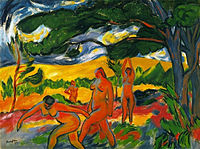
Max Pechstein, 1911, Nether the Copse (Akte im Freien), oil on canvas, 73.half-dozen ten 99 cm (29 x 39 in)
-

Governance [edit]
Director [edit]
The current director of the Detroit Institute of Arts, Salvador Salort-Pons a native of Madrid was previously caput of the European Art Department at the DIA. Before coming to the DIA he was senior curator at the Meadows Museum at SMU and prior to that an banana professor of art history at the Complutense Academy of Madrid. Salort-Pons holds a doctorate in art history from the Purple Spanish College at Italy's University of Bologna and an MBA from the Cox School of Business at Southern Methodist University in Dallas. On September 16, 2015, Salort-Pons was named as manager following the retirement of Graham Beal in June.[60]
Criticism of Salort-Pons [edit]
Despite the increase in yearly visitors to the DIA, there is criticism that Salort-Pons is straying away from the "company-centered" philosophy pioneered by predecessor Graham Beal. Under this philosophy, the museum would make the art and interpretations of art more attainable to the full general public to help them learn and connect with the pieces on display.[61] Salort-Pons' Spanish origin has made critics believe he is unable to empathise and tackle the complication of bug surrounding race, inclusivity, and representation in the Usa. The New York Times reported that Salort-Pons was taking steps to improve diversity despite his express understanding of the Blackness struggle in America.[62] In an interview with Artnet News, Salort-Pons said the commitment to improve diversity in the DIA included "implementing diversity and customs date initiatives as well as hiring qualified POC candidates.[63] However, several POC candidates who were hired by Salort-Pons, such as Lucy Mensah, banana curator of gimmicky art in 2017, resigned due to a "toxic work environment" and believed they were "token hires" considering the DIA "premise some of their hires every bit a style of diversifying the voices of the establishment, only at the aforementioned time they don't actually appreciate those voices."[64]
Controversy Over 2019 "Apprehensive and Homo" Exhibition
Calls for greater racial sensitivity and honest interpretations of fine art suitable for immature patrons came after Paul Gauguin's painting "Spirit of the Dead Watching" was included in the multi-gallery show. The painting depicted a 13-yr-former Tahitian girl named Teha'amana, who Gauguin took as his wife, naked on a bed. Gauguin was 44 years old.[63] In June 2020, sometime DIA digital experience designer Andrea Montiel de Shuman, a Mexican adult female, published an essay online announcing her resignation, citing "Spirit of the Dead Watching" every bit an example of the museum's sub-par engagement with nonwhite audiences.[65] Montiel de Shuman claimed the artworks' label did not address the possibility that the artist sexually abused her, gave her syphilis, and colonized her home. Montiel de Shuman, in an email to the Detroit Free Press, said "[I] asked how the DIA was preparing front-line staff to handle conversations around power dynamics, colonial corruption, and sexual assault - particularly of minors."[65] The museum did not publicly respond to Montiel de Shuman's resignation, simply releasing a general statement that they "[practice] non make media statements regarding individual employment matters."[65]
Marketing [edit]
Besides holding major art exhibitions inside the museum'due south i,150-seat theatre and almanac formal entertainment fundraising galas such as Les Carnavel des ArtStars in Nov,[66] [67] other Detroit Constitute of Arts coordinated events include the almanac "Fash Fustigate," a leading corporate sponsored way event, featuring celebrities and models that showcase the latest manner trends, typically held in the Renaissance Eye's Winter Garden, the Pull a fast one on Theatre, or at the Detroit Found of Arts theatre in August to celebrate Detroit Fashion Calendar week.[68] [69] A 2012 survey showed 79 percentage of the establish's annual visitors lived in ane of the three surrounding counties Wayne (which includes Detroit), Macomb, and Oakland.[lxx] The museum'south annual attendance was 429,000 in 2011 and rose to 594,000 in 2013.[71] In 2014, the museum's annual omnipresence was virtually 630,000.[1]
Finance [edit]
One of the largest, nearly meaning art museums in the Us, the Detroit Institute of Arts relies on individual donations for much of its financial support. The museum has sought to increase its endowment balance to provide it financial independence. The City of Detroit owns the museum building and drove, but withdrew the metropolis'southward financial support. The museum'south endowment totaled $200 meg in 1999 and $230 million in 2001. The museum completed a major renovation and expansion in 2007. Past 2008, the museum'south endowment reached $350 million; notwithstanding, a recession, reduced contributions, and unforeseen costs reduced the endowment residual to critical levels.[66]
In 2012, the endowment totaled $89.3 meg and provided an annual return of about $3.4 million in investment income; while admissions, the museums cafe restaurant, and merchandise and volume sales from the museum's gift shop generated about $3.v million a yr, or just 15 percent of the annual budget. The museum raised $60 meg from 2008 to 2012, reduced staffing, and reduced its almanac operating upkeep from $34 million in 2008 to 25.4 meg in 2012.[66] [70] In 2012, voters in 3 of the major metropolitan counties approved a property tax levy or millage for a duration of 10 years, expected to raise $23 million per year, saving the museum from cuts. In Baronial 2012, the museum website expressed appreciation to the voters for their support. The Museum offers Wayne, Oakland, and Macomb County residents free full general admission for the 10-year duration of the millage canonical in 2012.[72] In 2012, the museum established an updated fund raising goal for its endowment residue to reach $400 million by 2022 in order to exist self-sustaining, while the millage is in upshot.[seventy] [73]
The DIA art drove is valued in billions of dollars, upwards to $8.5 billion co-ordinate to a 2014 estimate.[four] [5] After city'due south bankruptcy filing July 18, 2013, creditors targeted a part of the museum's collection that had been paid for with city funds as a potential source of acquirement. State-appointed emergency managing director Kevin Orr hired Christie's Auction House to assess the collection. After months of determining the off-white market value of the portion of the fine art that was purchased with urban center funds, Christie's released a report December 19, 2013, maxim that the collection of nearly 2,800 pieces of the and then city-owned artwork, was worth $454 million to $867 meg, with one masterpiece by Van Gogh worth upwardly to $150 meg.[74] [75] To prevent possible sale of the works, museum proponents developed what has been named the 1000 bargain. Nether the programme, which was somewhen canonical, the museum would raise $100 million for its portion, nine private foundations pledged $330 million, and the state of Michigan would contribute $350 meg for a total of $820 million in order to guarantee municipal workers' pensions. In return, the city of Detroit would transfer its portion of the collection and the building to the not-profit entity that already operates the museum.[76] This programme was challenged by other creditors, who claimed that information technology treated them unfairly and requested to bear their own appraisal of the museum collection.[77] Some creditors came forward with offers from other parties to buy the artworks for sums higher than Christie'due south appraisal.[78] On May xiii, 2014, Detroit emergency manager Kevyn Orr asked Detroit automakers to add $195 million to make the thou bargain stronger.[79] The eventual settlement did not require the DIA to sell any art.[80]
The discovery in 2014 that DIA President Graham West. J. Beal and Executive Vice President Anne Erickson received significant raises in 2014 and $fifty,000 bonuses in 2013 raised concerns amidst Wayne, Macomb and Oakland County residents.[81] [82] [83] The DIA board notified suburban authorities November 4, 2014, that information technology reimbursed the museum $ninety,000 for bonuses awarded to iii top executives in 2013.[84]
On Jan viii, 2015, Aggravate announced he was stepping downwardly on June 30.[85] Months later, Beal's pay connected to generate negative headlines for the DIA. Oakland County officials were at the forefront of opposition to a retroactive raise for Beal, even though the coin was raised from individual donations.[86] [87] [88] Some local lawmakers hoped to make the non-profit DIA subject to the Freedom of Information Human action.[89]
| Detroit Institute of Arts financials[66] [70] | |||||
|---|---|---|---|---|---|
| Projections based on achieving $35 million in almanac fundraising | |||||
| Category | 2013 | 2022 | 2023 | 2030 | 2038 |
| $ Fundraising Cumulative est. | 35,000,000 | 350,000,000 | 385,000,000 | 630,000,000 | 910,000,000 |
| $ Endowment Balance est. | 89,000,000 | 468,600,000 | 516,500,000 | 718,900,000 | 982,200,000 |
| $ Investment Income† | 3,400,000 | 17,800,000 | nineteen,600,000 | 27,300,000 | 37,300,000 |
| $ Millage | 23,000,000 | 23,000,000 | 0 | 0 | 0 |
| $ Sales† | 2,000,000 | 2,300,000 | 3,500,000 | iv,000,000 | 4,100,000 |
| $ Operating Revenue | 28,400,000 | 43,100,000 | 23,100,000 | 31,300,000 | 41,400,000 |
| $ Annual Expenditures† | 25,400,000 | thirty,200,000 | 30,800,000 | 35,400,000 | 40,900,000 |
| $ +/- | three,000,000 | 12,900,000 | (seven,700,000) | (4,100,000) | 500,000 |
| † – Annual sales estimates reflect gratis admission for Wayne, Oakland, and Macomb county residents for millage years. Expenditures ascension nigh 1.9% annually for aggrandizement. Investments yield nearly 3.viii% annually. | |||||
Run across too [edit]
- Cranbrook Art Museum
- Edsel and Eleanor Ford House
- List of art museums
- List of well-nigh visited art museums in the world
- University of Michigan Museum of Art
References [edit]
- ^ a b c d due east f "Museum Fact Canvass — The Detroit Plant of Arts". Dia.org. Archived from the original on 2015-06-27. Retrieved 2015-07-12 .
- ^ a b c d "About the DIA". Detroit Institute of Arts. Archived from the original on 2015-06-27. Retrieved 2015-06-26 .
- ^ "DIA's drove has national luster". The Detroit News . Retrieved 2014-11-23 .
- ^ a b Kennedy, Randy (28 July 2014). "New Appraisal Sets Value of Detroit Institute Artworks at Upwards to $viii.5 Billion". The New York Times . Retrieved 2014-eleven-08 .
- ^ a b Gibson, Eric (2014-07-15). "A Dose of Common Sense for Detroit". WSJ. Retrieved 2015-07-12 .
- ^ AIA Detroit Urban Priorities Committee (10 January 2006). "Look Inside: Top x Detroit Interiors". Model D Media. Retrieved 2014-03-24 .
- ^ "Company Figures 2013: Museum and exhibition attendance numbers compiled and analysed" (PDF). The Art Newspaper, International Edition. April 2014. Retrieved 2015-07-12 .
- ^ "Fine art at the DIA". The Detroit Institute of Arts . Retrieved 23 Feb 2019.
- ^ "The Puppets Are Coming, The Puppets Are Coming! Detroit Institute of Arts to unveil new puppet gallery Dec" (Printing release). dia.org. 22 November 2010. Retrieved 2011-05-16 .
- ^ "Artists' Take on Detroit: Projects for the Tricentennial — Events & Exhibitions at The Detroit Found of Arts". Dia.org. Archived from the original on 2015-09-08. Retrieved 2015-07-12 .
- ^ "Art in Focus: Celadons — Events & Exhibitions at The Detroit Institute of Arts". Dia.org. Archived from the original on 2015-09-07. Retrieved 2015-07-12 .
- ^ "Over The Line, The Art and Life of Jacob Lawrence — Events & Exhibitions at The Detroit Institute of Arts". Dia.org. Archived from the original on 2015-09-08. Retrieved 2015-07-12 .
- ^ "Over the Line. The Art and Life of Jacob Lawrence – Detroit Plant of Arts (DIA) – Fine art of the twenty-four hour period". Art-of-the-day.info. 2002-05-19. Retrieved 2015-07-12 .
- ^ "Degas and the Trip the light fantastic toe — Events & Exhibitions at The Detroit Institute of Arts". Dia.org. Archived from the original on 2015-09-08. Retrieved 2015-07-12 .
- ^ "Magnificenza! The Medici, Michelangelo and The Art of Late Renaissance Florence — Events & Exhibitions at The Detroit Institute of Arts". Dia.org. Archived from the original on 2015-09-08. Retrieved 2015-07-12 .
- ^ "When Tradition Changed: Modernist Masterpieces at the DIA — Events & Exhibitions at The Detroit Plant of Arts". Dia.org. Archived from the original on 2015-09-08. Retrieved 2015-07-12 .
- ^ "Then and Now: A Choice of 19th- and 20th-Century Fine art past African American Artists — Events & Exhibitions at The Detroit Institute of Arts". Dia.org. Archived from the original on 2015-09-08. Retrieved 2015-07-12 .
- ^ "Art in Focus: Buddhist Sculpture — Events & Exhibitions at The Detroit Institute of Arts". Dia.org. Archived from the original on 2015-09-08. Retrieved 2015-07-12 .
- ^ "Yoko Ono'south Freight Train — Events & Exhibitions at The Detroit Institute of Arts". Dia.org. Archived from the original on 2015-09-08. Retrieved 2015-07-12 .
- ^ "Yoko Ono's Freight Railroad train on DIA's South Lawn". Imaginepeace.com. Retrieved 2015-07-12 .
- ^ "Art in Focus: Mother-of-Pearl Inlaid Lacquer — Events & Exhibitions at The Detroit Institute of Arts". Dia.org. Archived from the original on 2015-09-08. Retrieved 2015-07-12 .
- ^ "Style of the Century: Selected Works from the DIA'due south Collection — Events & Exhibitions at The Detroit Institute of Arts". Dia.org. Archived from the original on 2015-09-08. Retrieved 2015-07-12 .
- ^ "Some Fluxus: From the Gilbert and Lila Silverman Fluxus Collection Foundation — Events & Exhibitions at The Detroit Institute of Arts". Dia.org. Archived from the original on 2015-09-08. Retrieved 2015-07-12 .
- ^ "Dance of the Forest Spirits: A Set of Native American Masks at the DIA — Events & Exhibitions at The Detroit Establish of Arts". Dia.org. 2003-ten-06. Archived from the original on 2015-09-08. Retrieved 2015-07-12 .
- ^ "Dawoud Bey: Detroit Portraits — Events & Exhibitions at The Detroit Institute of Arts". Dia.org. Archived from the original on 2015-09-08. Retrieved 2015-07-12 .
- ^ "Pursuits and Pleasures: Baroque Paintings from the Detroit Found of Arts — Events & Exhibitions at The Detroit Institute of Arts". Dia.org. Archived from the original on 2015-09-08. Retrieved 2015-07-12 .
- ^ "The Etching Revival in Europe: Late Nineteenth-and Early on-Twentieth Century French and British Prints — Events & Exhibitions at The Detroit Institute of Arts". Dia.org. Archived from the original on 2015-09-08. Retrieved 2015-07-12 .
- ^ "The Photography of Charles Sheeler: American Modernist — Events & Exhibitions at The Detroit Constitute of Arts". Dia.org. Archived from the original on 2015-09-08. Retrieved 2015-07-12 .
- ^ "Murano: Glass From the Olnick Spanu Collection — Events & Exhibitions at The Detroit Plant of Arts". Dia.org. Archived from the original on 2015-09-08. Retrieved 2015-07-12 .
- ^ "Gerard ter Borch: Master Works, Feb. 27 – May 22". Dia.org. Retrieved 2015-07-12 .
- ^ "Across Large: Oversized Prints, Drawings and Photographs — Events & Exhibitions at The Detroit Institute of Arts". Dia.org. Archived from the original on 2015-09-07. Retrieved 2015-07-12 .
- ^ "Lx-8th Annual Detroit Public Schools Student Exhibitions — Events & Exhibitions at The Detroit Institute of Arts". Dia.org. Archived from the original on 2015-09-08. Retrieved 2015-07-12 .
- ^ "Camille Claudel and Rodin: Fateful See — Events & Exhibitions at The Detroit Institute of Arts". Dia.org. Archived from the original on 2015-09-08. Retrieved 2015-07-12 .
- ^ "African American Art from the Walter O. Evans Collection — Events & Exhibitions at The Detroit Institute of Arts". Dia.org. Archived from the original on 2015-09-08. Retrieved 2015-07-12 .
- ^ "69th Annual Detroit Public Schools Student Exhibition — Events & Exhibitions at The Detroit Institute of Arts". Dia.org. Archived from the original on 2015-09-08. Retrieved 2015-07-12 .
- ^ "Recent Acquisitions: Prints, Drawings, and Photographs — Events & Exhibitions at The Detroit Institute of Arts". Dia.org. Archived from the original on 2015-09-08. Retrieved 2015-07-12 .
- ^ "The Big Three in Printmaking: Dürer, Rembrandt and Picasso — Events & Exhibitions at The Detroit Institute of Arts". Dia.org. Archived from the original on 2015-09-08. Retrieved 2015-07-12 .
- ^ "Annie Leibovitz: American Music — Events & Exhibitions at The Detroit Institute of Arts". Dia.org. Archived from the original on 2015-09-08. Retrieved 2015-07-12 .
- ^ "Ansel Adams — Events & Exhibitions at The Detroit Found of Arts". Dia.org. Archived from the original on 2015-09-08. Retrieved 2015-07-12 .
- ^ "70th Annual Detroit Public Schools Educatee Exhibition — Events & Exhibitions at The Detroit Institute of Arts". Dia.org. Archived from the original on 2015-09-08. Retrieved 2015-07-12 .
- ^ "The Best of the All-time: Prints, Drawings, and Photographs from the DIA Collection — Events & Exhibitions at The Detroit Institute of Arts". Dia.org. Archived from the original on 2015-09-08. Retrieved 2015-07-12 .
- ^ a b The Compages of the Detroit Institute of Arts. The Detroit Constitute of Arts. 1928.
- ^ a b Ferry, W. Hawkins (ane October 2012). The Buildings of Detroit: A History. Detroit: Wayne State University Press. pp. 220–222. ISBN978-0814316658.
- ^ a b "Information technology All Began with an Art Show". The Detroit News. detnews.com. half dozen November 2007. Retrieved 2010-09-twenty .
- ^ "Chapel". www.dia.org . Retrieved 2021-04-26 .
- ^ Witsil, Frank (June 15, 2021). "Downton Abbey fame leads to Meadow Brook Hall architect getting credit he deserves". Detroit Costless Press. (subscription required)
- ^ Berman, Ann E. (July 2001). "The Edsel & Eleanor Ford House". Architectural Digest . Retrieved 2012-01-22 .
- ^ a b Schjeldahl, Peter (28 November 2011). "The Painting on the Wall". The New Yorker. pp. 84–85. Retrieved 2012-01-12 .
- ^ Stremmel, Kerstin (2004). Realism . Taschen. pp. fourscore–81. ISBN978-3-8228-2942-4 . Retrieved 2012-01-12 .
- ^ Vivian Baulch; Patricia Zacharias (11 July 1997). "The Rouge plant – the fine art of industry". The Detroit News. detnews.com. Archived from the original on 17 July 2012. Retrieved 2011-02-24 .
- ^ White, Theo B. (1973). Paul Philippe Cret: Architect and Teacher . Philadelphia: The Art Alliance Press. pp. 33–34. ISBN9780879820084 . Retrieved 2014-xi-08 .
- ^ Gonyea, Don (2009). "Detroit Manufacture: The Murals of Diego Rivera". National Public Radio. Retrieved 12 Jan 2012.
- ^ Freudenheim, Tom L. (fourteen August 2010). "When the Motor City Was a Symbol of Strength". The Wall Street Periodical . Retrieved 2012-01-12 .
- ^ a b Ament, Lucy (22 January 2008). "The New DIA: The Architects". Model D Media. Retrieved 2010-12-06 .
- ^ Linett, Peter (January 2009). "Focus on the Detroit Establish of Arts". Curator: The Museum Periodical. 52 (one): xiii–33. doi:10.1111/j.2151-6952.2009.tb00330.10.
- ^ "Detroit Museum of Art — Historic Detroit". Historicdetroit.org. Retrieved 2015-07-12 .
- ^ a b c d e f m "A Brief History of the Detroit Plant of Arts" (PDF). Phillips Oppenheim. Archived from the original (PDF) on 2016-03-04. Retrieved 2015-08-31 .
- ^ WJRO. "Report Apropos Electric current Approaches of United States Museums To Holocaust Era Art Claims June 25, 2015"
- ^ "Masterpiece Back On View Subsequently Mucilage Incident" (Press release). Detroit Institute of Arts. 30 June 2006. Archived from the original on 25 March 2014. Retrieved 2014-03-24 .
- ^ Hodges, Michael H. "Salort-Pons named DIA's new director". Detroit News . Retrieved 29 September 2015.
- ^ Hodges, Michael H. (xix November 2020). aces-struggle-leadership-perceived-inside-exterior-detroit-institute-arts/34023270 "In DIA Director Salort-Pons, a Disconnect between How He'south Seen inside, Outside the Museum". The Detroit News.
- ^ Bowley, Grahama (19 November 2020). "Has the Detroit Establish of Arts Lost Bear on With Its Dwelling Town?". The New York Times.
- ^ a b "'In that location'due south No One on Staff Who Tin Atomic number 82': Former Detroit Institute of Arts Employees Accuse Its Director of Mismanagement and Ethics Violations". artnet News. 2020-07-17. Retrieved 2020-11-twenty .
- ^ Bousquette, Isabelle. "DIA action group calls for museum director'south resignation, says more demands forthcoming". Detroit Free Press . Retrieved 2020-11-xx .
- ^ a b c Hooper, By Ryan Patrick. "Detroit museum's director on go out amid allegations of toxic culture, racial harassment". Detroit Gratuitous Printing . Retrieved 2020-xi-20 .
- ^ a b c d Dobrzynski, Judith H. (1 August 2012). "Where There's a Mill, At that place's a Way". The Wall Street Journal . Retrieved 2014-03-24 .
- ^ "Detroit Institute of Arts agenda of events". Detroit Institute of Arts. Retrieved 2014-03-24 .
- ^ Hodges, Michael H. (xviii September 2003). "Michigan History: Play a trick on Theater's rebirth ushered in city'due south renewal". The Detroit News . Retrieved 2014-11-08 .
- ^ "Fash Bash 2011 at the Detroit Institute of Arts". dbusiness.com. July–August 2012.
- ^ a b c d Cohen, Patricia (eight Baronial 2012). "Suburban Taxpayers Vote to Back up Detroit Museum". The New York Times . Retrieved 2014-03-24 .
- ^ Pes, Javier; Sharpe, Emily (24 March 2014). "Visitor figures 2013: Taipei takes top spot with loans from Communist china". The Fine art Newspaper. Archived from the original on 2014-03-24. Retrieved 2014-03-24 .
- ^ Abdel-Razzaq, Laurén (8 August 2012). "Detroit Institute of Arts taxation easily passes in Wayne, Oakland". The Detroit News.
- ^ "With fine art collection saved, Detroit Institute of Arts looks to future". Freep.com. 2014-11-09. Retrieved 2015-07-12 .
- ^ "Christie's Values Detroit's Art At $454M-$867M". Bloomberg Businessweek. Associated Press. 19 December 2013. Retrieved 2014-11-08 .
- ^ "La collection du Detroit Constitute of Arts menace" [The collection of the Detroit Found of Arts threatened]. La Journal des Arts.fr (in French). 13 December 2013. Retrieved 2014-11-03 .
- ^ "Detroit va céder le DIA... au DIA !" [Detroit will sell the DIA...to the DIA!]. La Journal des Arts.fr (in French). 31 January 2014. Retrieved 2014-11-03 .
- ^ Bomey, Nathan (thirteen May 2004). "DIA seeks to cake removal of artworks for valuation in defalcation fight". Detroit Gratis Press . Retrieved 2014-11-03 .
- ^ O'Donnell, Nathan (23 April 2014). "Detroit Institute of Arts Grand Deal Non Done Yet, Creditors Merits to Have Purchaser Willing to Pay Nearly $two Billion for Entire Drove". Art Police force Written report . Retrieved 2014-11-03 .
- ^ Gray, Kathleen; Bomey, Nathan; Stryker, Mark (13 May 2014). "Orr pleads with lawmakers for M Bargain cash, creditors plot legal strategy". Detroit Free Press . Retrieved 2014-11-03 .
- ^ Bomey, Nathan; Helms, Matt; Guillen, Joe. "Judge OKs bankruptcy plan; a 'miraculous' effect". Detroit Free Press . Retrieved 2014-12-02 .
- ^ Laitner, Bill (23 October 2014). "DIA pay raises prompt leaders to demand changes". Detroit Gratis Press . Retrieved 2014-11-03 .
- ^ Turk, John (23 October 2014). "DIA lath chairman meets with Committee, hears communities' concerns over executives' by raises". The Oakland Press . Retrieved 2014-11-03 .
- ^ Chambers, Jennifer (23 October 2014). "Oakland Co. officials demand DIA return bonuses". The Detroit News . Retrieved 2014-11-03 .
- ^ Chambers, Jennifer (6 November 2014). "DIA board pays back $90K for execs' 2013 bonuses". The Detroit News . Retrieved 2014-xi-08 .
- ^ "Graham Beal's plans after DIA retirement upward in air". The Detroit News. Associated Press. January 8, 2015.
- ^ Detroit Gratis Printing: 'Some Oakland County officials protest DIA raises' by L.L. Brasier and Mark Stryker, Baronial 27, 2015.
- ^ Welch, Sheri (September 1, 2015). "Amid criticism over bonuses and pay hikes, DIA is searching for new director". Michigan Radio.
- ^ Burns, Gus (August 26, 2015). "Hefty bonuses for top Detroit Institute of Arts execs draw criticism". Mlive.
- ^ Hotts, Mitch (Baronial 27, 2015). "Macomb, Oakland lawmakers want DIA to be subject to Open Meetings, FOI acts". Oakland Printing.
Further reading [edit]
- Abt, Jeffrey (2001). A Museum on the Verge: A Socioeconomic History of the Detroit Found of Arts, 1882–2000. Detroit: Wayne State University Press. ISBN978-0814328415.
- Aggravate, Graham William John, Debra Northward. Mancoff, and the Detroit Institute of Arts Staff (2007). Treasures of the DIA: Detroit Found of Arts. Detroit Institute of Arts. ISBN978-0895581600.
{{cite book}}: CS1 maint: multiple names: authors list (link) - Colina, Eric J.; John Gallagher (2002). AIA Detroit: The American Institute of Architects Guide to Detroit Architecture . Wayne State University Press. ISBN978-0814331200.
- Meyer, Katherine Mattingly and Martin C.P. McElroy with Introduction by W. Hawkins Ferry, Hon A.I.A. (1980). Detroit Architecture A.I.A. Guide Revised Edition . Wayne State University Press. ISBN978-0-8143-1651-one.
{{cite book}}: CS1 maint: multiple names: authors listing (link) - Peck, William H. (1978). The Detroit Found of Arts: A Brief History. Wayne State University Printing. ISBN978-0895581358.
- WJRO (2015). World Jewish Restitution Organization Written report Concerning Current Approaches of U.s. Museums To Holocaust-Era Claims, June 25, 2015. WJRO.
External links [edit]
- Official Detroit Plant of Arts−DIA website
- Detroit Establish of Arts at Google Cultural Institute
- Detroit Establish of Arts at ARTSTOR
craddockefivishereme.blogspot.com
Source: https://en.wikipedia.org/wiki/Detroit_Institute_of_Arts

Post a Comment for "Sculpture of Goose and Woman in Love at the Detroit Institute of Arts"